Welcome to Day 1416 of our Wisdom-Trek, and thank you for joining me.
I am Guthrie Chamberlain, Your Guide to Wisdom
Mastering the Bible – Intolerant Apostles and Cryptic Revelations – Worldview Wednesday
Wisdom – the final frontier to true knowledge. Welcome to Wisdom-Trek! Where our mission is to create a legacy of wisdom, to seek out discernment and insights, to boldly grow where few have chosen to grow before. Hello, my friend, I am Guthrie Chamberlain, your captain on our journey to increase Wisdom and Create a Living Legacy. Thank you for joining us today as we explore wisdom on our 2nd millennium of podcasts. Today is Day 1416 of our Trek, and it is Worldview Wednesday. Creating a Biblical Worldview is essential to have a proper perspective on today’s current events. To establish a Biblical Worldview, you must have a proper understanding of God and His Word. Our focus for the next several months on Worldview Wednesday is Mastering the Bible, through a series of brief insights. These insights are extracted from a book of the same title from one of today’s most prominent Hebrew Scholars, Dr. Micheal S. Heiser. This book is a collection of insights designed to help you understand the Bible better. When we let the Bible be what it is, we can understand it as the original readers did, and as its writers intended. Each week we will explore two insights.
Mastering The Bible – Intolerant Apostles and Cryptic Revelations
Insight Seventy-Five: The Apostles Didn’t Tolerate Aberrant Teaching about the Gospel
 Both testaments of the Bible bear witness to the problem of competing religious ideas that were contrary to biblical faith and theology. In the Old Testament period, the polytheistic religious systems of the surrounding nations were a persistent threat to Israel’s exclusive loyalty to Yahweh as the true God. That loyalty was the core of Israel’s faith and the basis for salvation in the Old Testament. Deuteronomy 6:4 Listen, O Israel! The Lord is our God, the Lord alone.
In the New Testament period, idolatry and the danger of worshipping a lesser god was still a target of apostolic teaching and writing. Paul admonished the Corinthians to be careful about eating meat sacrificed to idols, warning them that, in doing so, they were at risk of committing idolatry and fellowshipping with demons (1 Corinthians 10:14-22). Since Paul elsewhere permits eating such meat (1 Corinthians 8:4, 7-9), advising believers not to make a fuss about offerings that were sold in the marketplace (1 Corinthians 10:25), the issue for Paul must have been avoiding any sort of activity that either was participation in the ritual or could be construed that way.
The more significant problem of false teaching, however, seems to involve teachers that professed to follow Jesus but whose teachings altered the simplicity of the Gospel— that salvation was only by grace through faith (Ephesians 2:8-9) and was available to Jews and gentiles alike.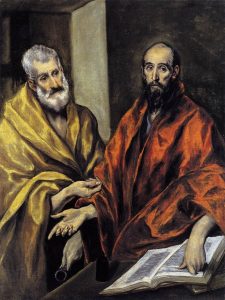 Paul and the other apostles repeatedly had to deal with “Judaizers,” who argued that gentiles had to conform to specific points of the Mosaic law to be in right standing before God. Paul referred to those who taught such things as “the circumcision party” and famously confronted Peter for his failure to oppose their teaching (Galatians 2:11-14). Peter knew better but was afraid to speak against Judaizing at Antioch. Paul referred to his behavior as “hypocrisy” that was “out of step with the gospel” (Galatians 2:13-14). The Judaizing seems to have been focused on circumcision (and therefore Jewish identity) since Paul later accuses the Judaizers themselves of being lawbreakers (Galatians 6:13). The point is that they had focused on outward conformity to Jewish identity and not the heart. They presumed that being Jewish meant superior status with God.
Peter himself would later have a problem with false teaching. He, along with Jude, had to confront self-proclaimed prophets who rejected moral authority (Jude 4, 8-10). These false teachers were apparently professing Christians since they participated in the Lord’s Supper (Jude 12). Jude rejected their profession, charging that they didn’t have the Holy Spirit (Jude 19).
As the Epistles show us, we shouldn’t tolerate teaching that alters the Gospel or encourages a life devoid of biblical morals. When it comes to false teaching, tolerance is no virtue.
Insight Seventy-Six: Revelation Is Hard to Interpret Because Apocalyptic Prophecy Isn’t Designed to Be Clear
 Even though there’s a lot in the Bible that is difficult to understand, most of it was written for clarity. That isn’t the case with Revelation. The last book of the New Testament is a classic example of what scholars call the apocalyptic genre. The Greek name of the book. John’s apokalypsis (“Apocalypse”) makes that clear.
Revelation is just one of many apocalyptic texts that have survived from antiquity. The normative features of apocalyptic literature are well known, and Revelation has them in abundance. Apocalyptic books aim to reveal the future, specifically of the end of human history, in a cryptic fashion. Apocalyptic secrets are heavenly and not of earth. For that reason, the genre communicates its message in visions and uses angelic mediators to convey its secrets. John’s book derives from visions he saw in heaven (e.g., Revelation 4:1-6; 9:17; 10:8; 12:10; 14:2; 19:11). Angels appear in Revelation over fifty times, and in many cases, they give John insight into those heavenly visions (Revelation 1:1; 17:7, 15; 19:9; 22:1, 6). Despite this help, the content of the book is called a mystery several times (e.g., Revelation. 10:7; 17:5, 7).
Unsurprisingly, the book is riddled with symbolic language: unidentified “elders,” spirits, living creatures full of eyes (Revelation 4-5); scrolls with seals, celestial signs (sun, moon, stars; Revelation 6, 9); angels with trumpets (Revelation 9, 11); a great fiery Abyss from which emerge locusts (Revelation 9); a dragon (Revelation 12): beasts emerging from the sea and the earth (Revelation 13): and the great prostitute (Revelation 17).
Basically all of this imagery comes from the Old Testament. Unfortunately for us, the imagery was symbolic to begin with, and Revelation at times changes the contexts and nature of the images. But our real disadvantage is that we come from another time and culture. While ancient readers would have instantly understood particular symbols, our understanding is anything but intuitive since we don’t share their Worldview. A deliberately cryptic book, therefore, becomes even more obtuse. To have any hope of understanding the book, we need to first understand the meaning of the metaphors and symbols in the Old Testament and then read carefully for how John uses the Old Testament.
If that sounds like work, it is. And it gets worse. A lot hinges on discerning when the book was written, which in large part depends on one passage in the book that is difficult to interpret. On top of that, it’s unclear whether we should read the book as a chronological sequence of events or as a series of repeating cycles. The choice of reading strategy leads to dramatically different conclusions about the book’s meaning. The dismaying truth is that Revelation isn’t easy to understand because it wasn’t meant to be easy to understand. For that reason, be very suspicious of anyone who tells you they’ve figured it out.
That will conclude this week’s lesson on another two insights from Dr. Heiser’s book “Mastering The Bible.” Next Worldview Wednesday, we will continue with two additional insights. I believe you will find each Worldview Wednesday an interesting topic to consider as we build our Biblical Worldview.
Tomorrow we will continue with our 3-minute Humor nugget that will provide you with a bit of cheer, which will help you to lighten up and live a rich and satisfying life. So encourage your friends and family to join us and then come along with us tomorrow for another day of ‘Wisdom-Trek, Creating a Legacy.’ If you would like to listen to any of our past 1415 treks or read the Wisdom Journal, they are available at Wisdom-Trek.com. I encourage you to subscribe to Wisdom-Trek on your favorite podcast player so that each day’s trek will be downloaded automatically.
Thank you so much for allowing me to be your guide, mentor, and, most of all, your friend as I serve you in through this Wisdom-Trek podcast and journal.
As we take this Trek together, let us always:
- Live Abundantly (Fully)
- Love Unconditionally
- Listen Intentionally
- Learn Continuously
- Lend to others Generously
- Lead with Integrity
- Leave a Living Legacy Each Day
I am Guthrie Chamberlain….reminding you to ’Keep Moving Forward,’ ‘Enjoy your Journey,’ and ‘Create a Great Day…Everyday’! See you Tomorrow!
 The apostle Paul spoke the truth about God, the Father, Son, and Spirit. Paul wrote about God’s desire for a new covenant people where we are all equal and united in God.
  Significant prejudice is undoubtedly not a new issue. It has been with humanity since the beginning of creation. Let’s look back in the first century, shortly after the time of Christ. Almost everyone in the earliest days of the church was Jewish. Prejudice was a significant problem. Sometimes that prejudice manifested itself toward non-Jews who were coming to Christ and being added to the church, which was the dominant problem addressed in Acts chapters 10-15. However, prejudice was also an issue between sub-groups within the Jewish community. Grecian Jews who were in Jerusalem, and who had become disciples of Christ, made an accusation of discrimination. Their widows who did not speak the native language in Jerusalem were being overlooked and were going hungry while the native-speaking widows were receiving better care and more ample provision as the early Christians shared their possessions. Sharing of provisions is found in
 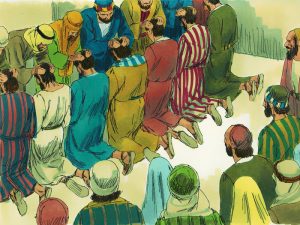 Meditate on these ten principles of great leadership and congregational problem-solving that are listed above. These are great principles to put into practice among Christians today. All of society would benefit from them. Every problem has the potential for disaster or development. Led by the Holy Spirit, the apostles turned this potentially crippling problem into an opportunity for the development and growth of Christ disciples.
 Perhaps the notion will be foreign to you, but I have met Christians who presume that material wealth and personal success are proof of God’s blessing. There are whole ministries that play on people’s emotions that support this unbiblical philosophy. It doesn’t take much thought to realize how unbiblical that proposition is. Many unbelievers are financially prosperous and quite successful. Conversely, many believers have next to nothing. They aren’t poor or persecuted because they don’t have enough faith or because they haven’t sent money to a ‘television ministry.’ They are poor for a plethora of reasons, some of them quite complex and systemic to their political and cultural situation. But if they are faithful, they are also blessed.
 Perhaps the most poignant contradiction to the notion that wealth and prosperity defines the blessing of God is Jesus himself. Jesus was homeless and dependent on the support of others (Matthew 8:20; Mark 15:40-41). His torture and crucifixion for crimes he did not commit is the highest example of suffering for believers (1 Peter 2:19-23; 4:1; 5:1).
 Many Christians will no doubt be surprised, and perhaps disturbed, by this assertion. Yet it is something taught quite clearly in the Epistles. But from the outset of our brief look at the subject, we must be clear that “church discipline“ (as it has come to be called) had restoration of a sinning believer in view, not jaded shunning.
 If you would like to listen to any of our past 1410 treks or read the Wisdom Journal, they are available at Wisdom-Trek.com. I encourage you to subscribe to Wisdom-Trek on your favorite podcast player so that each day’s trek will be downloaded automatically.
 How do you restore your energies after you have reached the exhaustion point? What do you do when the fatigue debt has mounted so high in every dimension of your life — physical, emotional, and spiritual — that you do not think you can do one more thing? Where do you go for renewal when plenty of sleep doesn’t relieve the bone-weariness that pulses through every fiber of your being?
 For many of us who have found ourselves in such wearisome conditions, retreat and rest are often prescribed. They are also much desired. Yet many find such restful retreats remedy their weariness for just a short time, only to learn its return has left them feeling entirely and perpetually “burned out.”
 I am not surprised that when Jesus saw the weariness of his apostles, the Lord not only told them to go away to a quiet place, but he also called them to be with him. Getting away wasn’t enough. Resting and being alone, far away from the crowd, wouldn’t rekindle the holy fire they needed to minister. No matter how restful retreat from the maddening rush may seem at the time, getting away by itself will not restore what is spent. Only the presence of the Lord can renew, restore, revitalize, reinvigorate, and re-establish our spirits. Only the Spirit of God, the breath of heaven, can make dry bones rise again (
 If you would like to listen to any of the past 1403 daily treks or read the daily journal, they are available at Wisdom-Trek.com. I encourage you to subscribe to Wisdom-Trek on your favorite podcast player so that each day will be downloaded to you automatically.