Welcome to Day 1458 of our Wisdom-Trek, and thank you for joining me.
This is Guthrie Chamberlain, Your Guide to Wisdom
The Future of Food – Ask Gramps
Wisdom – the final frontier to true knowledge. Welcome to Wisdom-Trek! Where our mission is to create a legacy of wisdom, to seek out discernment and insights, to boldly grow where few have chosen to grow before. Hello, my friend, I am Guthrie Chamberlain, your captain on our journey to increase Wisdom and Create a Living Legacy. Thank you for joining us today as we explore wisdom on our 2nd millennium of podcasts. Today is Day 1458 of our Trek, and our focus on Fridays is the future technological and societal advances, so we call it Futuristic Fridays. My personality is one that has always been very future-oriented. Since my childhood, I have yearned for the exploration and discovery of new technologies and advancements for the future. I grew up with the original Star Trek series, and even today, while I am on my 64th revolution around the sun, I still dream of traveling in space. Each week we will explore rapidly converging technologies and advancements, which will radically change our lives. At times, the topics may sound like something out of a science fiction novel, but each area that we explore is already well on its way of becoming a reality over the next couple of decades.
To keep with our theme of “Ask Gramps,” I will put our weekly topics in the form of a question to get us on track. So this week’s question is, Hey Gramps, technological advances are moving so quickly. With the world population growing briskly, how will technology impact food in the future?
The Future of Food (Part 2)
 Last week we focused on the first part of how exponential technologies are impacting food production. This week we will continue exploring how food production is changing rapidly. I am using some of the information mentioned in Peter Diamandis’s blogs and book “The Future is Faster Than You Think.”
Could a hamburger grown in a lab from Kobe beef stem cells be cheaper, better tasting, and healthier for you?
Can you imagine a future where millions of square miles of pastoral land are reclaimed by nature, creating new forests and revitalizing the Earth’s vital oxygen making?
Last week, we discussed the hyper-efficient food production systems of 2030. This week, we continue that discussion, but from a different perspective—because by the end of the next decade, we may witness the end of industrial animal agriculture as we know it.
Through the convergence of biotechnology and AgTech, we will witness the birth of the most ethical, nutritious, and environmentally sustainable food system ever devised by humankind.
Let’s dive in.
· Cultured Meat
 Meat production is often problematic. A quarter of the planet’s available landmass is currently used to keep 20 billion chickens, 1.5 billion cattle, and 1 billion sheep alive—that is, until we can kill them and eat them. We also have to deal with all of the waste and by-products associated with the butchering of animals.
Here are some statistics that will open your eyes. One out of seven Americans will go to bed hungry tonight, yet farm animals consume 30 percent of the world’s food crops. It is much more exaggerated in most developing countries. Worse is the water involved. Meat production accounts for 70 percent of global water use. Compared to 1,500 liters required to produce a kilogram of wheat, it takes 15,000 liters to produce a kilogram of beef, meaning there’s enough water in an adult steer to float a U.S. Navy destroyer. While this next statistic may be debatable, it is projected that meat production is also responsible for 14.5 percent of all greenhouse gases and a considerable portion of our deforestation problem as land is cleared for pastures.
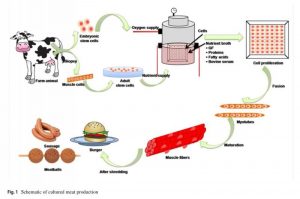
So what is the solution as meat consumption continues to rise throughout the world? One answer is cultured meat, which is meat that is grown from a few cells into a full-blown steak. Cultured meat is produced by taking a few stem cells from a live animal, typically via a biopsy, so the animal isn’t harmed. Feed these cells a nutrient-rich solution. Power the whole process in bioreactors. Give the industry a few years to mature and the technology a few years to shed costs, and, finally, we can produce an infinite number of steaks to feed an increasingly carnivorous population.
As with any emerging technology, there are still numerous hurdles to overcome in the process, but we are fast approaching the point at which converging exponential technologies will enable this transformation of today’s food system.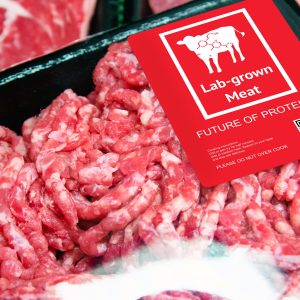 Environmental issues aside, cultured meat has the potential to become far more cost-effective than conventional meat. It will soon compete with the latter on almost every market-oriented criteria in existence.
For starters, cultured meat production is mostly an automated process without much need for land or labor. Plus, it takes a few months or years to grow a cow on farms, but only a few weeks to produce a cow’s worth of steak in the lab.
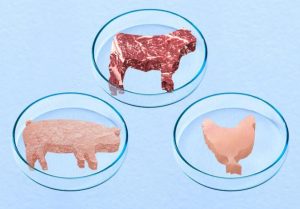
It’s more than just steak. The meats in development range from pork sausage and chicken nuggets to lamb and filet mignon—it all depends on which stems cells you start with.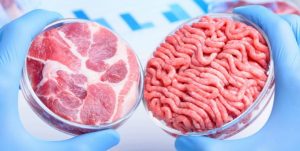 In late 2018, for example, a company called, Just Foods announced a partnership with Japanese Wagyu beef producer Toriyama to develop cultured meat from the cells of what has long been the rarest and most expensive steaks on Earth.
What is possible with cultured meat is also true for milk. Perfect Day Foods, a Berkeley, California-based company started by two founders with a passion for cheese, has figured out how to make the animal-derived product without any involvement from cows. Combining gene sequencing with 3D printing and fermentation science, they’ve created a line of animal-free dairy products.
So what does this all mean? These food changes will bring about a fundamental reconfiguration of the way we source, consume, and pay for food, with much lower environmental costs.
· The Benefits
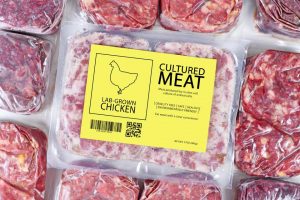 Such a transformation will revamp our world in ways we have only begun to imagine.
Imagine what this will mean as the world population grows to over 10 billion by 2050, which is only 30 years from now. The reduction of resources alone is considerable. Cultured meat uses 99 percent less land, 82-96 percent less water, and produces 78-96 percent fewer greenhouses gases.
Energy use drops somewhere between 7 and 45 percent, depending on the meat involved. As an example, traditional chicken ranching is much more energy-intensive than conventional beef ranching.
If we can free up a quarter of our landmass, we will have more land available for humans. We can also reforest, providing sufficient renewable materials to support that growth.
While that’s a lot of numbers to consider, what they add up to is astounding: An ethical and environmental solution to population growth and world hunger.
It’s also a much healthier solution. As we will soon be growing steak from stem cells, we can do the impossible: Make fast food hamburgers that are actually good for you. We’ll be newly able to increase essential proteins, reduce saturated fat, even add vitamins.
Another huge win: cultured meat requires no antibiotics. Given the danger of diseases like mad cow disease, next-gen meat consumption will be far safer for humans, reducing—if not eliminating—the food industry’s industrial hygiene challenges.
Since 70 percent of emerging diseases come from livestock, by turning to cultured meat, we’re both lowering the global disease burden and decreasing our risk of a pandemic.
· Food in 2030
Over the last two weeks, we have explored how converging exponentials will revolutionize one of humanity’s most basic needs.
By the end of the next decade, anyone anywhere will have on-demand, ultra-cheap access to lab-grown meat— far more nutritious than livestock-derived products, with a near-zero carbon footprint and safety guarantees.
As we have all had to adapt to during the Covid-19 pandemic, we may not always want to venture out to shop. The rapidly changing exponential technologies in food production will allow us more choices. The rise of vertical farming, autonomous drone networks, and last-mile delivery advancements will make food deliverable to your doorstep, sourced from a low-land use food production center. “Local foods” will be truly local. Either that, or download physiology-optimized recipes to your in-home food 3D printer. These exponential food technologies are starting to sound like the Star Trek food replicators already.
While traditional agriculture has experienced shifts and industrialization, growing food has roughly been the same since the beginning of human history.
Soon to undergo one of the most monumental technological revolutions in history, our food system is about to be leagues more efficient, ethical, and sustainable than ever before—not to mention far healthier.
In just a few years, humans will become the first animal that derives our protein from other animals, yet doesn’t harm anyone in the process. Meat miles—that is, the transportation costs involved in moving meat around—will nearly disappear. Slaughterhouses will become a story we tell our grandchildren. A planet that is already significantly strained for producing enough food under the weight of seven billion people will have a fighting chance for food abundance as we grow to 10 billion by 2050.
Even with these exciting food technologies that are coming in the next couple of decades, we know that as Christ-followers, we do not have to be anxious or worried, for God will take care of us. He may just use some of these technologies as His instruments.
“That is why I tell you not to worry about everyday life—whether you have enough food and drink, or enough clothes to wear. Isn’t life more than food, and your body more than clothing? Look at the birds. They don’t plant or harvest or store food in barns, for your heavenly Father feeds them. And aren’t you far more valuable to him than they are?
That is a wrap for today’s question. Join us again next Futuristic Friday as we look at Virtual Reality – From Deceptive to Disruptive on our ‘Ask Gramps’ episode. Our next trek is Meditation Monday, where we will help you reflect on what is most important in life. So encourage your friends and family to join us and then come along on Monday for another day of ‘Wisdom-Trek, Creating a Legacy.’ If you would like to listen to any of the past 1457 daily treks or read the associated journals, they are all available at Wisdom-Trek.com. I encourage you to subscribe to Wisdom-Trek on your favorite podcast player so that each day will be downloaded to you automatically.
Thank you for allowing me to be your guide, mentor, and, most of all, your friend as I serve you in through this Wisdom-Trek podcast and journal.
As we take this Trek of life together, let us always:
- Live Abundantly (Fully)
- Love Unconditionally
- Listen Intentionally
- Learn Continuously
- Lend to others Generously
- Lead with Integrity
- Leave a Living Legacy Each Day
I am Guthrie Chamberlain….reminding you to ’Keep Moving Forward,’ ‘Enjoy your Journey,’ and ‘Create a Great Day…Everyday’! See you on Monday!
 Sam seemed to be late for just about everything. As was his habit, Sam was running a little behind schedule when he arrives at the movie theater to watch a movie that he was really looking forward to it. Although Sam was late, he figured maybe the previews were still playing, so he goes in to watch the movie that has already started. He sat there for several minutes, allowing his eyes to adjust to the darkness and immediately became engrossed in the movie. After a few minutes, he was surprised to see a dog sitting beside its master in the row ahead of him. Sam noticed that the dog was actually intently watching the movie.
 I hope that brought a smile to your face today. If it did pass your smile onto some else, we all could use a kind smile each day. Our Thursday thought is, “Outside of a dog, a book is a man’s best friend. Inside of a dog, it’s too dark to read.”
 If you would like to listen to any of our past 1456 treks or read the Wisdom Journal, they are all available at Wisdom-Trek.com. I encourage you to subscribe to Wisdom-Trek on your favorite podcast player so that each day will be downloaded to you automatically.
 In previous weeks we explored if the council of God referred to the trinity or idols. Neither of those options were logical or based on Scripture. One of the other options when people raise the following questions, “Well, maybe these plural elohim aren’t really divine beings; they’re not really gods.” “Maybe they are something else. Maybe they are people.” “Maybe Psalm 82 has God talking to a council of leaders, Jewish leaders, elders, Israelites, you know, some human beings here.”
 We have one more common trajectory to address in terms of people trying to identify the plural elohim of Yahweh’s council in Psalm 82 and some of these other passages. The question naturally comes up, “Well, are these angels?” Well, it’s kind of like six of one and a half dozen of the other. The specific term for “angel” in the Hebrew Bible (mal’akh) is not used in these or other council passages. Heavenly host terminology, though, does show up, and of course, angels are part of the heavenly host.
 If you would like to listen to any of our past 1455 treks or read the Wisdom Journal, they are available at Wisdom-Trek.com. I encourage you to subscribe to Wisdom-Trek on your favorite podcast player so that each day’s trek will be downloaded automatically.
 Three primary mindsets influence a person’s outlook on life. Some people are past-oriented, and most decisions made are influenced strongly by what happened in the past. Some people are present-oriented, and current circumstances strongly influence most decisions, that is what is happening now. The remainder of the people are future-oriented, and most decisions are made from the perspective of what could be in the future. I tend to be very future-oriented, and do not allow what happened in the past, or my current situation to hinder what I think is a future possibility. Regardless of what perspective is dominant in your decision making, all of us are bound by our past. We cannot deny being strongly influenced by circumstances and experiences that make us who we are today. Our history is both positive and negative. The negative aspects of our past need to be our tutors which help us to make wise decisions in the future. The positive aspects of our history need to be our sage advisers allowing us to build on that strong foundation, which will enable us to excel and impact others as we build God’s kingdom here on earth. Regardless of your primary outlook on life and decision making, know that whatever baggage we bring with us from the past, whether it be good or ill, we can learn from it to be better tomorrow than we are today. Life is a trek, and each day that we live is another opportunity to be who God destined us to be.
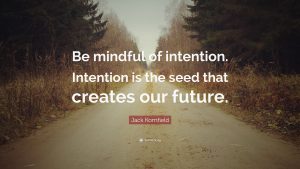 That’s a wrap for today’s Wisdom Unplugged quote. If you would like free access to my database of over 11,000 inspirational quotes, the link is available on the main page of Wisdom-Trek.com. Just as you enjoy these nuggets of wisdom, encourage your friends and family to join us and then come along tomorrow for another day of ‘Wisdom-Trek, Creating a Legacy.’
  If you would like to listen to any of our past 1454 treks or read the Wisdom Journal, they are available at Wisdom-Trek.com. I encourage you to subscribe to Wisdom-Trek on your favorite podcast player so that each day’s trek will be downloaded automatically.
 Every reader who is married knows that marriage is an adjustment. Although Paula and I have had very few issues in our marriage, the honeymoon phase does indeed end. Couples may love each other, but conflict eventually surfaces. One piece of sage advice for handling conflicts that I have read at various times is offered in the form of a question: Do you want to be happy, or do you want to be right? I suspect that you catch the meaning. Winning a debate and making your spouse happy aren’t interchangeable ideas.
 Dr. Heiser shares that before he decided to go to graduate school, he spent some time in seminary. One of his professors was known for his memorable phrases. One of his off-the-cuff quips has stuck with Dr. Heiser for decades: “If you don’t think the ministry is hard work, you aren’t in it.” As with most professional careers, they are hard work. While I never went into the pastorate, this phrase rings through the corridors of my mind whenever I think about Bible study. It lends itself to a suitable adaptation: If you don’t think Bible study is work, you aren’t doing it.
 Others associate Bible study with “getting a blessing.” In doing so you confuse devotional Bible reading with Bible study. The goal of Bible study isn’t a spiritual buzz. Bible study isn’t in search of a feeling. It’s in search of understanding what the biblical text says and what it means. That isn’t to suggest personal application is irrelevant or ought to be avoided. Instead, it’s to suggest that “applying” anything in the Bible without knowing what it means is at best useless and at worst dangerous.
 If you would like to listen to any of the past 1453 daily treks or read the daily Journal, they are available at Wisdom-Trek.com. I encourage you to subscribe to Wisdom-Trek on your favorite podcast player so that each day will be downloaded to you automatically.