Welcome to Day 1460 of our Wisdom-Trek, and thank you for joining me.
This is Guthrie Chamberlain, Your Guide to Wisdom
All In! – Wisdom Unplugged
Wisdom – the final frontier to true knowledge. Welcome to Wisdom-Trek! Where our mission is to create a legacy of wisdom, to seek out discernment and insights, to boldly grow where few have chosen to grow before. Hello, my friend, I am Guthrie Chamberlain, your captain on our journey to increase Wisdom and Create a Living Legacy. Thank you for joining us today as we explore wisdom on our 2nd millennium of podcasts. This is Day 1460 of our Trek, and it is time for our 3-minute mini trek called Wisdom Unplugged. This short nugget of wisdom includes an inspirational quote with a little bit of additional content for today’s trek. Consider this your vitamin supplement of wisdom for today. So let’s jump right in with today’s nugget:
Today’s quote is from Vincent van Gogh, and it is: I am seeking, I am striving, I am in with all my heart.
All In!

How committed are you in the various segments of your life. How committed are you to your family and preserving a loving relationship? How committed are you to physical fitness and living a healthy lifestyle? How committed are you to improving yourself mentally and intellectually? How committed are you to maintaining healthy personal and social life with others? How committed are you to be prudent and wise in your financial dealings, and staying out of debt? How committed are you to your work and career, so you are successful in whatever job you do? Finally, how committed are you to maintaining a healthy, growing, and vibrant spiritual life where loving God and loving others is your highest calling? In all seven areas of life, to live to fulfill your God-given potential, you need to be continually seeking, to be continually striving, to be all in with all of your heart. It is then you can reflect and know that you are ALL IN! So continue on, because God is not finished with you until He calls you home to be with Him.
And I am certain that God, who began the good work within you, will continue his work until it is finally finished on the day when Christ Jesus returns.
So whether you eat or drink, or whatever you do, do it all for the glory of God.
That’s a wrap for today’s Wisdom Unplugged quote. If you would like free access to my database of over 11,000 inspirational quotes, the link is available on the main page of Wisdom-Trek.com. Just as you enjoy these nuggets of wisdom, encourage your friends and family to join us and then come along tomorrow for another day of ‘Wisdom-Trek, Creating a Legacy.’  If you would like to listen to any of our past 1459 treks or read the Wisdom Journal, they are available at Wisdom-Trek.com. I encourage you to subscribe to Wisdom-Trek on your favorite podcast player so that each day’s trek will be downloaded automatically.
Thank you for allowing me to be your guide, mentor, and most importantly, I am your friend as I serve you in through this Wisdom-Trek podcast and journal each day.
As we take this Trek of life together, let us always:
- Live Abundantly (Fully)
- Love Unconditionally
- Listen Intentionally
- Learn Continuously
- Lend to others Generously
- Lead with Integrity
- Leave a Living Legacy Each Day
I am Guthrie Chamberlain….reminding you to ’Keep Moving Forward,’ ‘Enjoy your Journey,’ and ‘Create a Great Day…Everyday’! See you tomorrow for Worldview Wednesday!



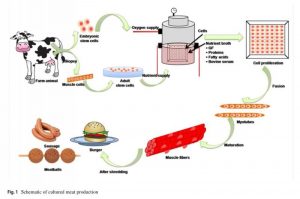 Last week we focused on the first part of how exponential technologies are impacting food production. This week we will continue exploring how food production is changing rapidly. I am using some of the information mentioned in Peter Diamandis’s blogs and book “The Future is Faster Than You Think.”
 Meat production is often problematic. A quarter of the planet’s available landmass is currently used to keep 20 billion chickens, 1.5 billion cattle, and 1 billion sheep alive—that is, until we can kill them and eat them. We also have to deal with all of the waste and by-products associated with the butchering of animals.
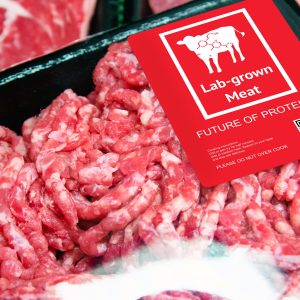 Environmental issues aside, cultured meat has the potential to become far more cost-effective than conventional meat. It will soon compete with the latter on almost every market-oriented criteria in existence.
 In late 2018, for example, a company called, Just Foods announced a partnership with Japanese Wagyu beef producer Toriyama to develop cultured meat from the cells of what has long been the rarest and most expensive steaks on Earth.
 Such a transformation will revamp our world in ways we have only begun to imagine.
 If you would like to listen to any of the past 1457 daily treks or read the associated journals, they are all available at Wisdom-Trek.com. I encourage you to subscribe to Wisdom-Trek on your favorite podcast player so that each day will be downloaded to you automatically.
 Sam seemed to be late for just about everything. As was his habit, Sam was running a little behind schedule when he arrives at the movie theater to watch a movie that he was really looking forward to it. Although Sam was late, he figured maybe the previews were still playing, so he goes in to watch the movie that has already started. He sat there for several minutes, allowing his eyes to adjust to the darkness and immediately became engrossed in the movie. After a few minutes, he was surprised to see a dog sitting beside its master in the row ahead of him. Sam noticed that the dog was actually intently watching the movie.
 I hope that brought a smile to your face today. If it did pass your smile onto some else, we all could use a kind smile each day. Our Thursday thought is, “Outside of a dog, a book is a man’s best friend. Inside of a dog, it’s too dark to read.”
 If you would like to listen to any of our past 1456 treks or read the Wisdom Journal, they are all available at Wisdom-Trek.com. I encourage you to subscribe to Wisdom-Trek on your favorite podcast player so that each day will be downloaded to you automatically.
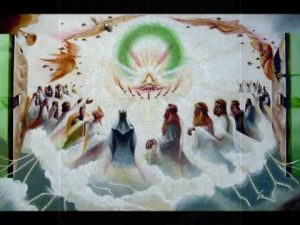 In previous weeks we explored if the council of God referred to the trinity or idols. Neither of those options were logical or based on Scripture. One of the other options when people raise the following questions, “Well, maybe these plural elohim aren’t really divine beings; they’re not really gods.” “Maybe they are something else. Maybe they are people.” “Maybe Psalm 82 has God talking to a council of leaders, Jewish leaders, elders, Israelites, you know, some human beings here.”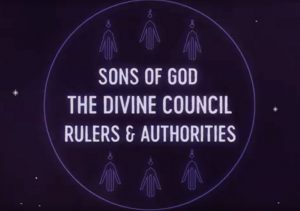
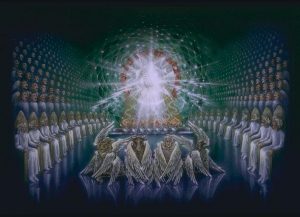 We have one more common trajectory to address in terms of people trying to identify the plural elohim of Yahweh’s council in Psalm 82 and some of these other passages. The question naturally comes up, “Well, are these angels?” Well, it’s kind of like six of one and a half dozen of the other. The specific term for “angel” in the Hebrew Bible (mal’akh) is not used in these or other council passages. Heavenly host terminology, though, does show up, and of course, angels are part of the heavenly host.
 If you would like to listen to any of our past 1455 treks or read the Wisdom Journal, they are available at Wisdom-Trek.com. I encourage you to subscribe to Wisdom-Trek on your favorite podcast player so that each day’s trek will be downloaded automatically.