Welcome to Day 1488 of our Wisdom-Trek, and thank you for joining me.
This is Guthrie Chamberlain, Your Guide to Wisdom
Artificial Intelligence and Shopping – Ask Gramps
Wisdom – the final frontier to true knowledge. Welcome to Wisdom-Trek! Where our mission is to create a legacy of wisdom, to seek out discernment and insights, to boldly grow where few have chosen to grow before. Hello, my friend, I am Guthrie Chamberlain, your captain on our journey to increase Wisdom and Create a Living Legacy. Thank you for joining us today as we explore wisdom on our 2nd millennium of podcasts. Today is Day 1488 of our Trek, and our focus on Fridays is the future technological and societal advances, so we call it Futuristic Fridays. My personality is one that has always been very future-oriented. Since my childhood, I have yearned for the exploration and discovery of new technologies and advancements for the future. I grew up with the original Star Trek series, and even today, as I am now on my 65th revolution around the sun, I still dream of traveling in space. Each week we will explore rapidly converging technologies and advancements, which will radically change our lives. At times, the topics may sound like something out of a science fiction novel, but each area that we explore is already well on its way of becoming a reality over the next couple of decades.
To keep with our theme of “Ask Gramps,” I will put our weekly topics in the form of a question to get us on track. This week’s question is, Hey Gramps, Covid-19 has accelerated the drive to online shopping, but what type of changes in retail shopping and customer service can we expect during this next decade?
Artificial Intelligence and Shopping
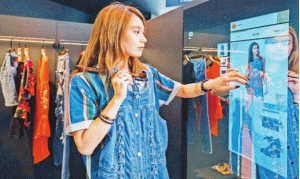
Last week our focus will be on the 3-D printing revolution. This week we will learn how Artificial Intelligence will change our shopping experiences. I am using some of the information mentioned in Peter Diamandis’s blogs and book “The Future is Faster Than You Think.”
AI and 5G broadband are radically changing retail shopping as we know it. During 2019, there were over 25 major retail bankruptcies. In 2020, especially with the on-going impact of Covid-19, the retail apocalypse is only accelerating.
What’s coming next is astounding. Why drive to a store when you can speak? Revenue from products purchased via voice commands is expected to quadruple from today’s $2 billion to $8 billion by 2023.
Virtual Reality, Augmented Reality, and 3D Printing are converging with AI, drones, and 5G to transform shopping on every dimension. As a result, shopping is becoming dematerialized, demonetized, democratized, and delocalized in a top-to-bottom transformation of the retail world.
A Day in the Life of 2030
Let’s time travel together to October 2, 2030, a sunny day in Dallas. You have an important speech to give at a luncheon tomorrow, but nothing to wear. The last thing you want to do is drive through congested traffic and spend several hours at the mall.
That is no longer a requirement. Your body image data is still current, as you were scanned only a week ago. Put on your VR headset and have a conversation with your AI.
“It’s time to buy a suit for tomorrow’s luncheon speech,” is all you have to say.
In a moment, you’re teleported to a virtual clothing store. Zero travel time. No freeway traffic, parking hassles, or angry hordes wielding baby strollers.
Instead, you’ve entered your own personal clothing store. Everything is in your exact size. I mean everything. The store has access to nearly every designer and style on the planet.
Ask your AI to show you what’s hot in Paris, France, and presto, you have an instant fashion show. Every model you see looks exactly like you, only dressed in Paris’s latest design.
When you’re done selecting an outfit, your AI pays the bill. As your new clothes are being 3D-printed at a warehouse—before speeding your way via drone delivery—a digital version has been added to your personal inventory for use at future virtual events.
The cost? Thanks to an era of no middlemen, less than half of what you pay in stores today. Yet this future is not all that far off..maybe only ten years
Digital Assistants

Let’s transport back to today and begin with the basics: the act of turning desire into a purchase.
Most of us navigate shopping malls or online marketplaces alone, hoping to stumble across the right item and fit. If you’re fortunate enough to employ a personal assistant, you have the luxury of describing what you want to someone who knows you well enough to buy that exact right thing most of the time. But let’s come back to reality, since for most of us who don’t. In the not too distant future, we can turn to our digital assistant.
Right now, the four horsemen of the retail apocalypse are waging war for our wallets. Amazon’s Alexa, Google’s Now, Apple’s Siri, and Alibaba’s Tmall Genie are going head-to-head in a battle to become the platform du jour for voice-activated, AI-assisted commerce.
For baby boomers like myself, who grew up watching Captain Kirk talk to the Enterprise’s computer on Star Trek, digital assistants seem a little like science fiction. But for millennials, it’s just the next logical step in a world that is auto-magical.
As those millennials enter their consumer prime, revenue from products purchased via voice-driven commands is projected to leap from four-fold in the next three years.
We already see a significant change in purchasing habits. On average, consumers using Amazon Echo spent more than standard Amazon Prime customers: $2,000 versus $1,500. As far as an AI fashion advisor goes, those are already available, courtesy of both Alibaba and Amazon.
During its annual Singles’ Day shopping festival, Alibaba’s FashionAI concept store uses deep learning to make suggestions based on human fashion experts’ advice and store inventory. This deep learning drives a significant portion of the day’s $25 billion in sales. Similarly, Amazon’s shopping algorithm makes personalized clothing recommendations based on user preferences and social media behavior.
Customer Service
But AI is disrupting more than just personalized fashion and e-commerce. Its next big break will take place in the customer service arena. According to a recent Zendesk study, good customer service increases the possibility of an increase in purchases of 42%. Lousy customer service translates into a 52% chance of losing that sale forever. This means more than half of us will stop shopping at a store due to a single disappointing customer service interaction.
These are significant financial stakes. They’re also problems perfectly suited for an AI solution.
During the 2018 Google I/O conference, CEO Sundar Pichai demoed the Google Duplex, their next-generation digital assistant. Pichai played the audience a series of pre-recorded phone calls made by Google Duplex. The first call made a reservation at a restaurant, the second one booked a haircut appointment, amusing the audience with a long “hmmm” mid-call. In neither case did the person on the other end of the phone have any idea they were talking to an AI. The system’s success speaks to how seamlessly AI can blend into our retail lives and how convenient it will continue to make them.
The same technology that Pichai demonstrated can make phone calls for consumers can also answer phones for retailers—a development that’s unfolding in two different ways:
· (1) Customer service coaches:
First, there’s Beyond Verbal, a Tel Aviv-based startup that has built an AI customer service coach for organizations interested in keeping humans involved.
Simply by analyzing customer voice intonation, the system can tell whether the person on the phone is about to blow a gasket, is genuinely excited, or anything in between.
Based on the research of over 70,000 subjects in more than 30 languages, Beyond Verbal’s app can detect 400 different markers of human moods, attitudes, and personality traits.
It’s already been integrated in call centers to help human sales agents understand and react to customer emotions, making those calls more pleasant and more profitable.
For example, by analyzing word choice and vocal style, Beyond Verbal’s system can tell what kind of shopper the person on the line is. If they’re an early adopter, the AI alerts the sales agent to offer them the latest and greatest. If they’re more conservative, it suggests items more tried-and-true.
· (2) Replacing customer service agents:
Second, companies like New Zealand’s Soul Machines are working to replace human customer service agents altogether. Powered by IBM’s Watson, Soul Machines builds lifelike customer service avatars designed for empathy, making them one of many helping to pioneer the field of emotionally intelligent computing.

With their technology, 40% of all customer service interactions are now resolved with a high degree of satisfaction, no human intervention is needed. Because the system is built using neural nets, it’s continuously learning from every interaction—meaning that percentage will continue to improve.
The number of these interactions continues to grow as well. Software manufacturer Autodesk now includes a Soul Machine avatar named AVA (Autodesk Virtual Assistant) in all of its new offerings. She lives in a small window on the screen, ready to soothe tempers, troubleshoot problems, and forever banish those long tech support hold times.
For Daimler Financial Services, Soul Machines built an avatar named Sarah, who helps customers with arguably three of modernity’s most annoying tasks: financing, leasing, and insuring a car.
This isn’t just about AI—it’s about AI converging with additional exponentials. Add networks and sensors to the story, and it raises the scale of disruption, upping the FQ—the frictionless quotient—in our frictionless shopping adventure.
Final Thoughts
AI makes retail cheaper, faster, and more efficient, touching everything from customer service to product delivery. It also redefines the shopping experience, making it frictionless and—once we allow AI to make purchases for us—ultimately invisible.
We need to be preparing for a future in which shopping is dematerialized, demonetized, democratized, and delocalized—otherwise known as “the end of malls.”
Within this next decade, it may not truly be an end to malls. They will be transformed into a more immersive, whimsical, and imaginative shopping experience complete with many other entertainment venues. Either way, it’s a top-to-bottom transformation of the retail world.
Changes like these mentioned today will also change how we interact with others as Christ-followers. Let’s be prepared for the changes and adopt them as we are able. These technologies will facilitate the building of God’s Kingdom on earth, as it is in heaven.
For the Kingdom of God is not just a lot of talk; it is living by God’s power.
That is a wrap for today’s question. Join us again next Futuristic Friday as we look at another exciting exponential technology area on our ‘Ask Gramps’ episode. Our next trek is Meditation Monday, where we will help you reflect on what is most important in life. So encourage your friends and family to join us and then come along on Monday for another day of ‘Wisdom-Trek, Creating a Legacy.’

If you would like to listen to any of the past 1487 daily treks or read the associated journals, they are available at Wisdom-Trek.com. I encourage you to subscribe to Wisdom-Trek on your favorite podcast player so that each day will be downloaded to you automatically.
Thank you for allowing me to be your guide, mentor, but most importantly, I am your friend as I serve you in through this Wisdom-Trek podcast and journal.
As we take this Trek of life together, let us always:
- Live Abundantly (Fully)
- Love Unconditionally
- Listen Intentionally
- Learn Continuously
- Lend to others Generously
- Lead with Integrity
- Leave a Living Legacy Each Day
I am Guthrie Chamberlain….reminding you to ’Keep Moving Forward,’ ‘Enjoy your Journey,’ and ‘Create a Great Day…Everyday’! See you on Monday!













 If you would like to listen to any of the past 1483 daily treks or read the daily Journal, they are available at Wisdom-Trek.com. I encourage you to subscribe to Wisdom-Trek on your favorite podcast player so that each day will be downloaded to you automatically.