Welcome to Day 1459 of our Wisdom-Trek, and thank you for joining me.
This is Guthrie Chamberlain, Your Guide to Wisdom
Bible Study – Its Aim Is Not Ignorance – Meditation Monday
Wisdom – the final frontier to true knowledge. Welcome to Wisdom-Trek where our mission is to create a legacy of wisdom, to seek out discernment and insights, and to boldly grow where few have chosen to grow before.
Hello, my friend, I am Guthrie Chamberlain, your captain on our journey to increase wisdom and create a living legacy. Thank you for joining us today as we explore wisdom on our 2nd millennium of podcasts. This is Day 1459 of our trek, and it is time for Meditation Monday. Taking time to relax, refocus, and reprioritize our lives is crucial in order to create a living legacy.
For you, it may just be time alone for quiet reflection. You may utilize structured meditation practices. In my life, meditation includes reading and reflecting on God’s Word and praying. It is a time to renew my mind, refocus on what is most important, and make sure that I am nurturing my soul, mind, and body. As you come along with me on our trek each Meditation Monday, it is my hope and prayer that you, too, will experience a time for reflection and renewing of your mind.
We are continuing our series this week on Meditation Monday as we focus on Mastering Bible Study through a series of brief insights from Hebrew Scholar, Dr. Michael S. Heiser. Our first few insights will focus on study habits to build a strong foundation. Today let us meditate on…
Bible Study – Its Aim Is Not Ignorance
· Insight Thirteen: The Aim of Bible Study is the Meaning of the Text, Not a Defense of Your View

The Bible is God’s Word—a repository of truths and information that, through human authors, God wanted to be preserved for posterity. Since the Bible is one of God’s means to transform our lives and direct our behavior, those who hold it in esteem have an emotional investment in it. They believe that it’s the expression of God’s will, not only for faith but also practice (2 Timothy 3:16-17).
Given all that’s riding on Bible study, it’s not hard to see why people who engage in it seriously sometimes argue about the results. Disagreements aren’t about an intellectual victory. Right and wrong are at stake; at least that’s the ideal. Sometimes that’s accurate. Other times it’s exaggerated.
Knowing precisely what the Bible means at every turn would require omniscience. Several passages are ambiguous. God knows omniscience isn’t an attribute we possess. Consequently, assigning a point of morality to every interpretive decision is unwise. It may sound sacrilegious, but a lot of the Bible—and hence, Bible study—doesn’t have a moral issue in view.

I’ve met many Christians who are so desperate to make sure their behavior is right and not wrong that they end up becoming better at arguing for what their family or tradition tells them a verse means than actually studying the matter for themselves. I’ve seen relationships destroyed over conflicting Bible interpretations where no core doctrinal teaching was at stake. I’ve seen believers driven to despair when friends or family members make an interpretation a litmus test for good standing before them and even before God.
The goal of Bible study shouldn’t be about finding ammunition to make someone guilty or shaming someone on the other side of a disagreement. It isn’t about finding ways to crush opposition or force a spiritual submission. You aren’t the Holy Spirit. It’s often better to kindly share what you believe and its basis in Scripture and then privately take your concerns to the Lord.
· Insight Fourteen: Ignorance Is Not a Gift of the Spirit
In this era of social media, we’ve all been exposed to people who have a knack for irritating and offending people they’ve never met. If you peruse comments on blogs or online forums to any extent, you know precisely who I’m talking about: the person who can’t seem to read anything without making sure everyone learns that they disagree and why, often in copious detail. So much for the global community.
Dr. Heiser has been blogging for years and has seen countless samples of incoherent, apoplectic ramblings. That doesn’t bother him. The dialogue he finds disturbing hits him in his soft ministry underbelly. As someone who’s spent many years in the classroom as a biblical studies professor, he cares that people want to learn Scripture. In his experience, a single overbearing spirit can poison the learning environment with disturbing speed and efficiency. The internet is the natural habitat of the “unteachable web dweller.”
You would think it would be easy for a professor to (pardon the pun) teach this type of student a lesson. This species often comes with an immunity: their appeal to ignorance as a virtue. Bringing up why the unteachable soul needs to rethink their dogmatic conclusion because of a point of Greek or Hebrew grammar has little effect when they’ve been trained to be suspicious of scholars. Appeals to Christian charity are harmlessly deflected when the target equates being uninfluenced by research with “defending the faith” (a tortured use of Jude 3).
I’m not recommending that Bible students bow to everything scholars say. For one thing, that would be impossible since scholars often disagree. For another, even scholarly conclusions are influenced by presuppositions. A committed Bible student needs to respect scholarship, not prostrate to it.
No one earns a Ph.D. without learning a great deal. That effort does indeed separate the scholar from most people. But the way to judge what a scholar says is not by extolling the virtues of ignorance. Instead, the committed Bible student will put in long hours to either confirm or critique what a given scholar says.
God doesn’t smile with more affection on someone who knows little about a subject, especially when that subject is the Bible. Willful resistance to thinking hard and long about the book we say is inspired is anything but a gift of the Spirit.
Study this Book of Instruction continually. Meditate on it day and night so you will be sure to obey everything written in it. Only then will you prosper and succeed in all you do.
That is a wrap for today’s meditation. Next week, we will continue our trek on Meditation Monday as we take time to reflect on what is most important in creating our living legacy. On tomorrow’s trek, we will explore another wisdom quote. This 3-minute wisdom supplement will assist you in becoming healthy, wealthy, and wise each day. Thank you for joining me on this trek called life. Encourage your friends and family to join us and then come along tomorrow for another day of our Wisdom-Trek, Creating a Legacy.

If you would like to listen to any of the past 1458 daily treks or read the daily Journal, they are available at Wisdom-Trek.com. I encourage you to subscribe to Wisdom-Trek on your favorite podcast player so that each day will be downloaded to you automatically.
Thank you for allowing me to be your guide, mentor, and most importantly, your friend as I serve you through the Wisdom-Trek podcast and journal.
As we take this trek together, let us always:
- Live Abundantly (Fully)
- Love Unconditionally
- Listen Intentionally
- Learn Continuously
- Lend to others Generously
- Lead with Integrity
- Leave a Living Legacy Each Day
I am Guthrie Chamberlain reminding you to Keep Moving Forward, Enjoy Your Journey, and Create a Great Day Everyday! See you tomorrow!
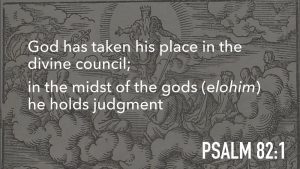
 In previous weeks we explored if the council of God referred to the trinity or idols. Neither of those options were logical or based on Scripture. One of the other options when people raise the following questions, “Well, maybe these plural elohim aren’t really divine beings; they’re not really gods.” “Maybe they are something else. Maybe they are people.” “Maybe Psalm 82 has God talking to a council of leaders, Jewish leaders, elders, Israelites, you know, some human beings here.”
 We have one more common trajectory to address in terms of people trying to identify the plural elohim of Yahweh’s council in Psalm 82 and some of these other passages. The question naturally comes up, “Well, are these angels?” Well, it’s kind of like six of one and a half dozen of the other. The specific term for “angel” in the Hebrew Bible (mal’akh) is not used in these or other council passages. Heavenly host terminology, though, does show up, and of course, angels are part of the heavenly host.
 If you would like to listen to any of our past 1455 treks or read the Wisdom Journal, they are available at Wisdom-Trek.com. I encourage you to subscribe to Wisdom-Trek on your favorite podcast player so that each day’s trek will be downloaded automatically.
 Participation Not Artificial
 Not Predetermined
 If you would like to listen to any of our past 1450 treks or read the Wisdom Journal, they are available at Wisdom-Trek.com. I encourage you to subscribe to Wisdom-Trek on your favorite podcast player so that each day’s trek will be downloaded automatically.
 Worry is so self-destructive since no amount of worry will result in a positive change in any situation. Worry in no way will control the future, except for the possibility of allowing circumstances to slide in a downward spiral. Only action can affect change, which will enable you to control the outcome of the future. Tied closely to worry is the impact that it will have on your happiness of your current situation in life. We only can be happy now, because there is never a time which is not the present. We can look forward to the possibility of a future time, but if worry steals from us the ability to be happy now, then there is little chance we will be happy when the future is now. So we must choose today not to worry, and we must choose today to be happy. That does not mean we don’t take action today to change our current circumstances if they need to be changed, but while we are taking action, we must choose not to worry and chose to be happy. To do so is really quite simple. The choice is up to you, and it a choice that you must make each day.
 If you would like to listen to any of our past 1449 treks or read the Wisdom Journal, they are available at Wisdom-Trek.com. I encourage you to subscribe to Wisdom-Trek on your favorite podcast player so that each day’s trek will be downloaded automatically.
 Last week on Futuristic Friday, we explored how Augmented Reality is and will impact significant sectors of industry. Today, we will focus on the implication and opportunity of AR. Our world is in a disruptive mode, which will speed up the exponential technology that is changing our world today. I am using some of the information mentioned in Peter Diamandis’s blogs and book “The Future is Faster Than You Think.”
 In Shopping mode, online merges with offline environments. Every storefront is only showing you things you desire; your AI knows precisely what you’re shopping for, what you need, what colors and fabrics you prefer. Specifications from price, color, and brand, are preferentially displayed by your AR headset. Your AI filters even the advertisements you see (or lack thereof).
 Local businesses that are inherently pertinent to you and your problems will auto-populate individualized data in your AR interface. Individuals’ backgrounds will pop up at networking events, particularly of those who share your industry, interests, or might be great partners for your next joint venture. That computing system you’ve just been shipped will guide you interactively through the assembly process—just give it a gaze and activate instructions with a blink.
 Screens go away: Your AR headset can project your watch, phone screen, health metrics, entertainment, anywhere, and to the scale you desire. We first dematerialized radios, calculators, measuring tapes, and almost every computing tool into a handheld device. But now, we are dematerializing screens themselves— seeing through interfaces, not looking into them.
 If you would like to listen to any of the past 1447 daily treks or read the associated journals, they are all available at Wisdom-Trek.com. I encourage you to subscribe to Wisdom-Trek on your favorite podcast player so that each day will be downloaded to you automatically.